
 Hyundai Azera: Repair procedures
Fifth generation HG (2011–2026) / Hyundai Azera 2011-2026 Service Manual / Engine Electrical System / Starting System / Repair procedures
Hyundai Azera: Repair procedures
Fifth generation HG (2011–2026) / Hyundai Azera 2011-2026 Service Manual / Engine Electrical System / Starting System / Repair procedures
Fifth generation HG (2011–2026) / Hyundai Azera 2011-2026 Service Manual / Engine Electrical System / Starting System / Repair procedures
| Starter Circuit Troubleshooting |
The battery must be in good condition and fully charged. |

| 1. |
Disconnect the injector connectors. |
| 2. |
With the shift lever in N or P (A/T) or clutch pedal pressed (M/T), turn the ignition switch to "START"
If the starter normally cranks the engine, starting system is
OK. If the starter will not crank the engine at all, go to next step.
If it won't disengage from the ring gear when you release key, check for the following until you find the cause.
|
| 3. |
Check the battery condition. Check electrical connections at
the battery, battery negative cable connected to the body, engine ground
cables, and the starter for looseness and corrosion. Then try starting
the engine again.
If the starter cranks the engine normally, repairing the loose connection repaired the problem. The starting system is now OK.
If the starter still does not crank the engine, go to next step. |
| 4. |
Disconnect the connector from the S-terminal of solenoid.
Connect a jumper wire from the B-terminal of solenoid to the S-terminal
of solenoid.
If the starter cranks the engine, go to next step.
If the starter still does not crank the engine, remove the starter, and repair or replace as necessary. |
| 5. |
Check the following items in the order listed until you find the open circuit.
|
Starter Solenoid Test
| 1. |
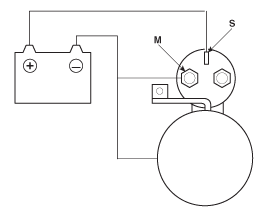
Disconnect the field coil wire from the M-terminal of solenoid switch. |
| 2. |
Connect the battery as shown. If the starter pinion pops out
(engages), it is working properly. To avoid damaging the starter, do not
leave the battery connected for more than 10 seconds.
|
| 3. |
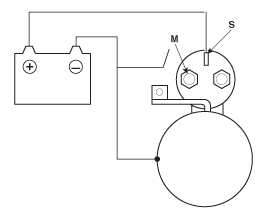
Disconnect the battery from the M terminal.
If the pinion does not retract, the hold-in coil is working
properly. To avoid damaging the starter, do not leave the battery
connected for more than 10 seconds.
|
| 4. |
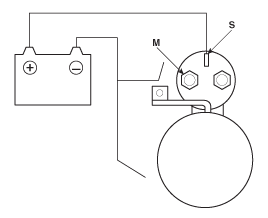
Disconnect the battery also from the body. If the pinion
retracts immediately, it is working properly. To avoid damaging the
starter, do not leave the battery connected for more than 10 seconds.
|
Free Running Test
| 1. |
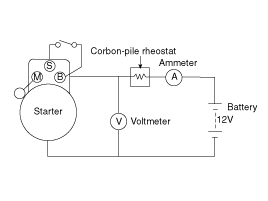
Place the starter motor in a vise equipped with soft jaws and
connect a fully-charged 12-volt battery to starter motor as follows. |
| 2. |
Connect a test ammeter (150-ampere scale) and carbon pile rheostats as shown in the illustration. |
| 3. |
Connect a voltmeter (15-volt scale) across starter motor.
|
| 4. |
Rotate carbon pile to the off position. |
| 5. |
Connect the battery cable from battery's negative post to the starter motor body. |
| 6. |
Adjust until battery voltage shown on the voltmeter reads 11.5volts. |
| 7. |
Confirm that the maximum amperage is within the specifications and that the starter motor turns smoothly and freely. |
Current : 85A, MAX.
Speed : 2,550rpm, MIN. |
 Description and Operation
Description
The starting system includes the battery, starter, solenoid
switch, ignition switch, inhibitor switch (A/T), clutch pedal switch
(M/T), ignition lock switch, connection wires and th ...
 Starter Components and Components Location
Component
1 . Front housing2. Planet gear shaft assembly3 . Lever4 . Lever packing5 . Starter solenoid assembly6 . Packing7 . Planet gear 8 . Shield9 . Armature assembly10 . York assembly11 . Br ...
See also:
Engine compartment
1. Engine oil dipstick
2. Engine oil filler cap
3. Engine coolant reservoir
4. Radiator cap
5. Brake fluid reservoir
6. Windshield washer fluid reservoir
7. Air cleaner
8. Positive batte ...
Fuel Filter Repair procedures
Removal
1.
Remove the fuel pump.
(Refer to Fuel Delivery System - “Fuel Pump�)
2.
Disconnect the electric pump wiring connector (A) and the fuel sender connector (B).
3.
Remove the c ...
Intake Air Temperature Sensor (IATS) Repair procedures
Inspection
1.
Turn the ignition switch OFF.
2.
Disconnect the IATS connector.
3.
Measure resistance between the IATS terminals 3 and 4.
4.
Check that the resistance is within the speci ...
Categories
Hyundai Azera Manuals

© 2011-2026 Copyright www.hgmanual.com