
 Hyundai Azera: Surge Tank Repair procedures
Fifth generation HG (2011–2026) / Hyundai Azera 2011-2026 Service Manual / Engine Mechanical System / Intake And Exhaust System / Surge Tank Repair procedures
Hyundai Azera: Surge Tank Repair procedures
Fifth generation HG (2011–2026) / Hyundai Azera 2011-2026 Service Manual / Engine Mechanical System / Intake And Exhaust System / Surge Tank Repair procedures
Fifth generation HG (2011–2026) / Hyundai Azera 2011-2026 Service Manual / Engine Mechanical System / Intake And Exhaust System / Surge Tank Repair procedures
| Removal and Installation |
| 1. |
Drain the coolant.
(Refer to Cooling System - "Coolant") |
| 2. |
Remove the air cleaner assembly.
(Refer to Intake And Exhaust System - "Air Cleaner") |
| 3. |
Disconnect the engine wiring connectors and harness protector on the surge tank.
|
| 4. |
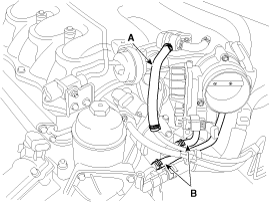
Disconnect the PCSV hose (A), and the throttle body water hoses (B).
|
| 5. |
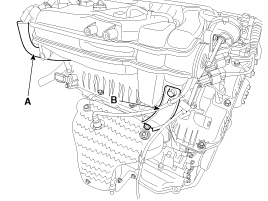
Disconnect the PCV hose (A), and then remove the surge tank stay (B).
|
| 6. |
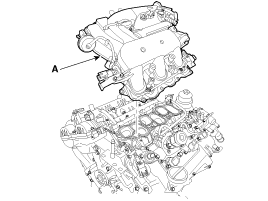
Remove the surge tank (A).
|
| 7. |
Installation is in the reverse order of removal. |
 Surge Tank Components and Components Location
Components
1. Surge tank2. Surge tank stay
...
 Intake Manifold Components and Components Location
Components
1. Intake manifold
...
See also:
Input Speed Sensor Description and Operation
Description
Input speed sensor is a vital unit that measures the rate of
rotation of the input shaft inside the transaxle and delivers the
readings to the Transaxle Control Module(TCM). The sen ...
License plate light bulb replacement
1. Turn off the engine.
2. Loosen the retaining screws with a philips head screwdriver.
3. Remove the bulb assembly by turning it counterclockwise.
4. Remove the bulb by pulling it straight out.
...
Snowy or icy conditions
To drive your vehicle in deep snow, it may be necessary to use snow tires or
to install tire chains on your tires. If snow tires are needed, it is necessary
to select tires equivalent in size and ty ...
Categories
Hyundai Azera Manuals

© 2011-2026 Copyright www.hgmanual.com