
 Hyundai Azera: Oil Cooler Repair procedures
Fifth generation HG (2011–2026) / Hyundai Azera 2011-2026 Service Manual / Automatic Transaxle System / Hydraulic System / Oil Cooler Repair procedures
Hyundai Azera: Oil Cooler Repair procedures
Fifth generation HG (2011–2026) / Hyundai Azera 2011-2026 Service Manual / Automatic Transaxle System / Hydraulic System / Oil Cooler Repair procedures
Fifth generation HG (2011–2026) / Hyundai Azera 2011-2026 Service Manual / Automatic Transaxle System / Hydraulic System / Oil Cooler Repair procedures
| Removal and Installation |
| 1. |
Remove the radiator upper hose and lower hose.
|
| 2. |
Remove the cooling fan assembly.
|
| 3. |
Disconnect the over flow hose.
|
| 4. |
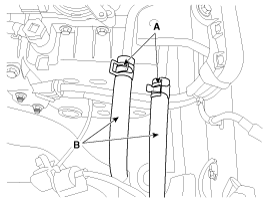
Disconnect the hose (B) after removing the automatic transaxle fluid cooler hose clamp (A).
|
| 5. |
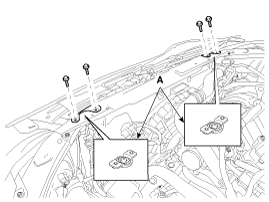
Remove the radiator mounting brackets (A).
|
| 6. |
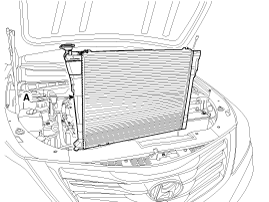
Separate the condenser from the radiator and then pull radiator (A) up and remove it from engine room.
|
| 7. |
Installation is in the reverse order of removal. |
| 8. |
Fill the radiator with coolant and check for leaks.
|

| Inspection |
Radiator Cap Testing
| 1. |
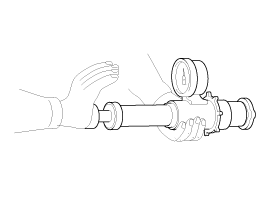
Remove the radiator cap, wet its seal with engine coolant, and then install it on a pressure tester.
|
| 2. |
Apply a pressure of 93.16 ~ 122.58kpa (0.95 ~ 1.25kg/cm?, 13.51 ~ 17.78psi). |
| 3. |
Check for a drop in pressure. |
| 4. |
If the pressure drops, replace the cap. |
Radiator Leakage Test
| 1. |
Wait until engine is cool, then carefully remove the radiator
cap and fill the radiator with engine coolant, then install it on the
pressure tester. |
| 2. |
Apply a pressure tester to the radiator and apply a pressure of 93.16 ~ 122.58kpa (0.95 ~ 1.25kg/cm?, 13.51 ~ 17.78psi). |
| 3. |
Inspect for engine coolant leaks and a drop in pressure. |
| 4. |
Remove the tester and reinstall the radiator cap.
|
 Oil Cooler Components and Components Location
Components
1. Radiator2. Radiator mounting bracket3. Radiator cap4. Drain plug5. Mounting insulator
...
 Oil Pump Description and Operation
Description
The oil pump is built-in as a single unit with the 26 Brake
chamber. Rotation of the pump builds the hydraulic pressure needed for
the lubrication of the various parts of the transa ...
See also:
Surge Tank Repair procedures
Removal and Installation
1.
Drain the coolant.
(Refer to Cooling System - "Coolant")
2.
Remove the air cleaner assembly.
(Refer to Intake And Exhaust System - "Air Cleaner")
3.
Disconn ...
Repair procedures
Inspection
Self Diagnosis With GDS
Smart key system defects can be quickly diagnosed with the
GDS. GDS operates actuator quickly to monitor, input/output value and
self diagnosis.
The followi ...
Pairing a Bluetooth® Wireless Technology Device
What is Bluetooth® Wireless Technology Pairing?
Pairing refers to the process of synchronizing your Bluetooth® Wireless Technology
phone or device with the car audio system for connection. Pairing ...
Categories
Hyundai Azera Manuals

© 2011-2026 Copyright www.hgmanual.com